
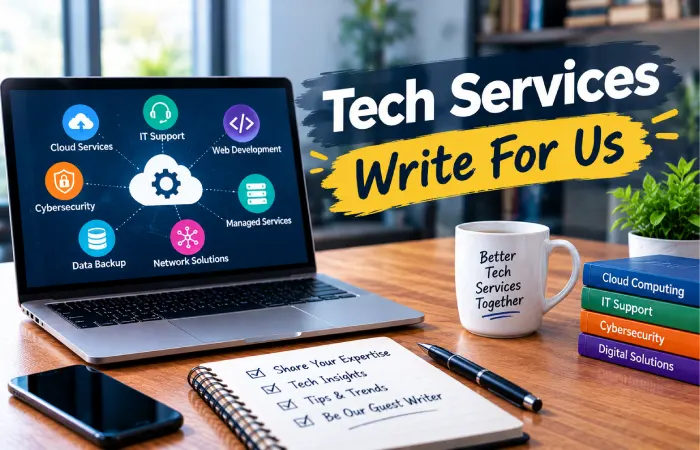
 Tech Services Write For Us
Technology services play an essential role in helping businesses operate efficiently, protect digital assets, improve customer experiences, and adapt to changing market demands. From IT support and cybersecurity to cloud computing, software development, and data analytics, technology services help organizations manage complex technical requirements without having to build every capability internally.
TechDirtBlog welcomes writers, IT professionals, developers, consultants, business owners, and technology enthusiasts to contribute original articles about tech services and related digital solutions. If you have practical knowledge of IT infrastructure, cloud platforms, technical support, cybersecurity, or technology consulting, we invite you to share your insights with our readers.
Our goal is to publish useful, easy-to-understand content that helps readers make informed decisions about technology services, explore emerging solutions, and understand how technology can support business growth.
Explore All Write For Us TopicsWhat Are Tech Services?
Tech services, also known as technology services, are professional services that help individuals and organizations implement, manage, maintain, and improve their technology systems. These services may be provided by an internal IT department, an external service provider, a specialized consultancy, or a managed services company.
The type of support required depends on an organization’s size, industry, budget, infrastructure, and business objectives. A small business might need assistance setting up computers, managing business email, and maintaining a website. A larger organization may require cloud infrastructure, advanced cybersecurity, software integration, data management, and round-the-clock technical monitoring.
Businesses can choose between in-house teams and third-party providers. An internal team offers direct oversight and familiarity with company operations, while an external provider may offer access to specialized expertise, established tools, and a wider range of technical capabilities.
The right approach depends on the organization’s needs, available resources, and long-term strategy.
Common Types of Technology Services
Technology service providers offer solutions across several areas. Understanding these services can help businesses identify operational problems and choose appropriate solutions.
1. IT Support and Technical Assistance
IT support helps businesses maintain their computers, networks, software, and other digital equipment. Common responsibilities include troubleshooting technical problems, configuring devices, managing user accounts, installing updates, and helping employees resolve software issues.
Depending on the service agreement, support may be delivered remotely, on-site, or through a combination of both. Reliable IT support reduces downtime and allows employees to focus on their core responsibilities.
2. Cybersecurity Services
Cybersecurity services help protect computer systems, applications, networks, and sensitive information against digital threats. Services may include vulnerability assessments, security monitoring, access control, endpoint protection, incident response planning, and employee security training.
Businesses should evaluate their security requirements based on the type of data they handle, the risks they face, and the regulations applicable to their industry. Regular updates, strong authentication, tested backups, and clear incident response procedures can help strengthen protection.
3. Software Development
Software development services involve designing, building, testing, deploying, and maintaining software applications. Providers may create custom business tools, mobile applications, web-based platforms, customer portals, or systems that connect existing business software.
Custom software can address specific operational needs, while ready-made applications may be more affordable and faster to implement. Organizations should compare functionality, integration requirements, maintenance costs, and future scalability before choosing an approach.
4. Web Development and Website Maintenance
Web development services cover website design, front-end and back-end development, content management systems, performance improvements, and ongoing maintenance. A reliable website helps businesses communicate with customers, showcase products, and provide access to important services.
Website maintenance may include software updates, security checks, backups, broken-link monitoring, and performance optimization. Businesses should also consider accessibility, mobile responsiveness, and user experience when developing or updating their websites.
5. Cloud Computing Services
Cloud computing allows businesses to access computing resources, storage, databases, networking, and software through cloud platforms. Depending on their requirements, organizations can use infrastructure services, managed development platforms, or ready-to-use cloud applications.
Cloud services can provide flexibility and help organizations adjust resources as their needs change. However, businesses should evaluate pricing, security responsibilities, data protection, service availability, and the possibility of vendor lock-in before migrating important workloads.
6. Data Analytics and Business Intelligence
Data analytics services help organizations collect, organize, analyze, and interpret information. Businesses can use these insights to understand customer behavior, evaluate performance, identify operational inefficiencies, and make better-informed decisions.
Service providers may support data cleaning, dashboard development, reporting, forecasting, and the integration of information from multiple systems. Accurate analysis depends on reliable data, appropriate methods, and a clear understanding of business objectives.
7. Digital Marketing and Search Optimization
Some technology service providers also support digital marketing through website analytics, search engine optimization (SEO), marketing automation, email campaigns, and social media tools. These services help businesses improve their online visibility and understand how audiences interact with their digital channels.
Businesses should choose marketing services based on measurable objectives, relevant experience, and transparent reporting rather than relying on unrealistic promises of rankings or guaranteed results.
Benefits of Using Tech Services
Working with the right technology service provider can offer several advantages to businesses of different sizes.
- Improved productivity: Reliable systems and timely technical assistance help employees spend less time dealing with technology problems.
- Cost management: Outsourcing selected services can reduce the need to hire and maintain a large in-house technical team, although the overall value depends on the contract and service requirements.
- Better security: Cybersecurity support can help organizations identify vulnerabilities, improve protection, and prepare for potential incidents.
- Access to expertise: Specialized providers may offer knowledge, tools, and experience that are difficult to maintain internally.
- Greater flexibility: Cloud services and managed technology solutions can help businesses adjust their technical resources as requirements change.
- Business continuity: Monitoring, maintenance, and tested recovery procedures can help reduce disruption when technical problems occur.
- Improved customer experience: Reliable websites, applications, and customer support systems make it easier for people to access services and resolve issues.
These benefits are not automatic. Businesses should define their goals, assess providers carefully, and monitor service performance to determine whether their investment is delivering value.
How to Choose the Right Tech Services Provider
Selecting a technology service provider requires more than comparing prices. Businesses should first identify their technical challenges, the outcomes they want to achieve, and the resources available to them.
Start by evaluating the provider’s experience with similar organizations and technologies. Ask about relevant projects, technical qualifications, support arrangements, and references where appropriate. A provider with experience in a comparable environment may better understand the organization’s requirements and potential challenges.
Request detailed quotations from multiple providers. Compare the scope of services, implementation costs, recurring fees, support hours, response times, exclusions, and contract terms. The lowest quotation may not represent the best value if it excludes essential services or provides limited support.
It is also important to establish clear expectations. Define responsibilities, communication procedures, service-level targets, data ownership, confidentiality requirements, and arrangements for ending the contract or transferring services to another provider.
Finally, consider the provider’s ability to support future growth. A solution that meets current needs should also be practical to maintain and adapt as the business develops.
Examples of Technology Service Providers
Several well-known companies provide cloud computing and enterprise technology services. Their offerings differ, so organizations should evaluate products according to their workloads, technical requirements, and budgets.
- Google Cloud: Provides cloud infrastructure, data analytics, artificial intelligence services, storage, and application development tools.
- Microsoft Azure: Offers cloud computing, networking, databases, identity management, analytics, and enterprise application services.
- Amazon Web Services (AWS): Provides a broad range of cloud infrastructure, storage, computing, database, security, and developer services.
- IBM: Offers enterprise technology solutions, consulting, hybrid cloud capabilities, and services supporting complex IT environments.
- Oracle Cloud: Provides cloud infrastructure, databases, enterprise applications, and business technology solutions.
These companies represent only a portion of the technology services market. Many regional providers and specialist firms offer IT support, managed services, software development, cybersecurity, and consulting for organizations with different budgets and requirements.
Emerging Trends in Tech Services
The technology services industry continues to evolve as businesses adopt new tools and operating models. Artificial intelligence is increasingly used to support service desks, automate repetitive tasks, analyze technical incidents, and assist with software development. Human oversight remains important, particularly when automated systems handle sensitive data or make consequential decisions.
Managed services are another important trend. Instead of handling every technical responsibility internally, organizations can contract providers to monitor systems, maintain infrastructure, manage selected security tasks, or provide ongoing support.
Cloud optimization is also receiving attention as businesses seek better control over technology spending. Organizations are reviewing resource usage, simplifying infrastructure, and selecting services that balance performance with cost.
At the same time, data privacy, cybersecurity, regulatory compliance, and business continuity remain major priorities. Companies increasingly need technology partners who can explain risks clearly and build practical solutions around their operational needs.
Writers can explore these trends through practical guides, informed analysis, case studies, and comparisons that help readers understand both the opportunities and limitations of new technology.
How to Submit Your Articles?
If you have useful knowledge about technology services, IT management, cloud computing, software development, cybersecurity, or related subjects, TechDirtBlog invites you to submit an original guest article.
Prepare a complete draft with a clear title, informative headings, accurate explanations, and practical takeaways. Articles should be written for readers who want to understand technology and apply it to real-world situations.
Please submit your article as a Word document or include the draft in your email. Add your proposed title and any relevant source references or image credits. Our editorial team reviews submissions for relevance, originality, accuracy, readability, and suitability for the website. We may edit content for clarity, grammar, formatting, and editorial consistency. Submission does not guarantee publication.
Send your article and proposed title to contact@techdirtblog.com for consideration.
Who Should Post on TechDirtBlog?
TechDirtBlog welcomes contributions from a broad range of people who can share valuable information about technology and digital solutions, including:
- IT professionals who understand technical support, infrastructure, and system administration.
- Cybersecurity specialists who can explain security practices, risks, and defensive strategies.
- Software developers and web developers with practical implementation experience.
- Cloud computing professionals who can discuss platforms, deployment, and infrastructure management.
- Technology consultants and business owners who have experience selecting or managing technology services.
- Writers and researchers who can explain technology trends in an accurate, accessible way.
- New contributors who have researched a relevant subject carefully and can provide original, useful insights.
You do not need to promote a company or product to contribute. We value articles that educate readers, explain problems, compare approaches fairly, and offer practical guidance.
Rules and Tips for Publishing Articles – Tech Services Write For Us
Follow these guidelines when preparing your guest article:
- Original writing: Submit unique content that has not been copied or republished from another source.
- Minimum word count: Articles must contain at least 900 words and provide sufficient depth without unnecessary repetition.
- Accuracy and clarity: Check facts, technical terminology, spelling, and grammar before submission.
- Relevant topics: Choose subjects related to technology services, IT support, cloud computing, cybersecurity, software, business technology, or related areas.
- Useful information: Include practical examples, clear explanations, and actionable recommendations where appropriate.
- Non-promotional content: Advertising articles, excessive self-promotion, and affiliate-focused submissions will not be accepted.
- Reliable sources: Cite relevant sources for statistics, research, and technical claims.
- Images: Include at least one relevant, high-resolution image that is royalty-free or otherwise properly licensed for use.
- Readable formatting: Use descriptive headings, short paragraphs, and lists when they improve the reader’s experience.
- Editorial review: TechDirtBlog reserves the right to edit submissions and determine whether an article meets its editorial standards.
Why Write for TechDirtBlog – Tech Services Write For Us
- TechDirtBlog welcomes fresh, unique, and informative content about technology services and related technology topics.
- Articles must be at least 900 words and provide useful information, advice, or insights about technology services.
- Promotional content, excessive self-promotion, and affiliate-focused articles are not accepted.
- Submit your original article and proposed title by emailing contact@techdirtblog.com.
- Related guest-post topics are welcome, including IT support, cloud computing, cybersecurity, software development, web services, and business technology.
Guidelines of the Article – Tech Services Write For Us
- TechDirtBlog welcomes fresh, unique, and informative content about technology services and related technology topics.
- Articles must be at least 900 words and provide useful information, advice, or insights about technology services.
- Promotional content, excessive self-promotion, and affiliate-focused articles are not accepted.
- Submit your original article and proposed title by emailing contact@techdirtblog.com.
- Related guest-post topics are welcome, including IT support, cloud computing, cybersecurity, software development, web services, and business technology.
Submit Your Tech Services Guest Post
Have practical experience with IT support, technology consulting, cloud platforms, cybersecurity, or software services? Share your knowledge with TechDirtBlog readers through an original, well-researched article.
Email your completed draft and proposed title to contact@techdirtblog.com for editorial consideration. We welcome informative contributions that help readers understand technology services and make better decisions about the tools and solutions they use.
Our “Write For Us” pages are created for writers, bloggers, content creators, and individuals who enjoy writing and reading informative blogs. These pages provide an opportunity for contributors to share original, useful, and reader-friendly content related to the topics listed on our website