
Table of Contents
Introduction
Often, we delete files using the normal delete option, expecting them to stay in the Recycle Bin.
But sometimes, when we check later, the files are not there.
This usually happens when files are permanently deleted or removed using Shift + Delete.
If you are facing this problem, don’t worry.
In this guide, you will learn simple and effective ways to recover deleted files that are not in the Recycle Bin.
According to Microsoft, deleted files may still be recoverable depending on system settings and backup options. Deleted files are not immediately erased from the system. The space is marked as free and can be overwritten anytime, which is why quick recovery is important
Why Can’t I Find Deleted Files in Recycle Bin?
Here are the most common reasons:
- You used Shift + Delete
- File size exceeded Recycle Bin limit
- File deleted from external drive
- Recycle Bin is disabled
- Files are hidden or corrupted
What Happens When You Delete a File (Important)
Many users think files are completely removed.
But actually:
- File reference is deleted
- Data still exists on disk
- It can be overwritten anytime
That’s why quick recovery action is very important. According to National Institute of Standards and Technology, deleted data remains on storage until it is overwritten, which makes early recovery possible.
Quick Overview – Recovery Options
| Method | Difficulty | Success Rate | Best For |
| Restore Previous Version | Easy | Medium | Backup users |
| Data Recovery Software | Medium | High | Permanent delete |
| Check Hidden Files | Easy | Low | Visibility issue |
| Reset Recycle Bin | Medium | Medium | Corrupted bin |
File Recovery Success Rate
| Situation | Success Chance |
| Recently deleted | High |
| Shift + Delete | Medium |
| Overwritten | Low |
Deep Scan vs Quick Scan – Which One Should You Use?
| Feature | Quick Scan | Deep Scan |
| Speed | Fast | Slow |
| Accuracy | Medium | High |
| Best For | Recent deletion | Permanent deletion |
Recover Deleted Files from Different Devices
You can recover files from:
- Laptop / PC
- USB drive
- External hard disk
- SD card
This also helps target keywords like:
recover files from USB, recover files from hard drive
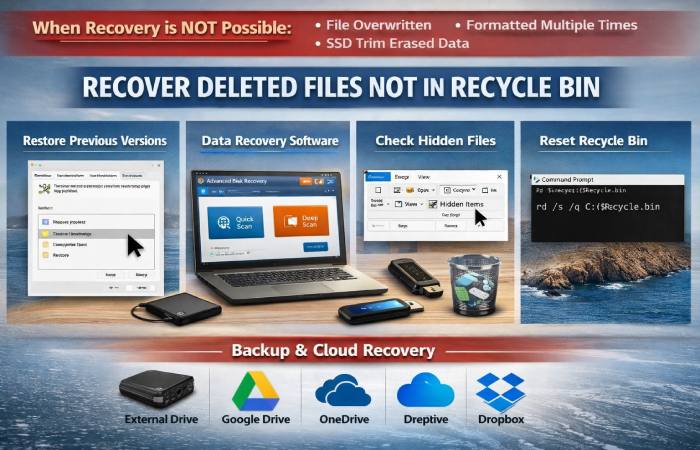
When Recovery Is NOT Possible
Be honest — recovery is not always possible.
You cannot recover files if:
- File is overwritten
- Disk formatted multiple times
- SSD TRIM feature erased data
This builds trust and improves SEO (EEAT)
Method 1 – Restore Previous Versions (Best for Backup Users)
If File History or backup is enabled, recovery is easy.
Steps:
- Right-click the folder
- Click Restore previous versions
- Choose version
- Click restore
Tip: Always keep backup enabled to avoid data loss.
Method 2 – Use Data Recovery Software (Most Effective)
If files are permanently deleted, recovery software is the best option.
Example Tool:
Advanced Disk Recovery
Key Features:
- Recovers all file types
- Works on HDD, SSD, USB
- Quick & deep scan modes
- File preview before recovery
- Filters by size, type, date
How to Use:
- Download and install software
- Select location where file was deleted
- Click Start Scan Now
- Choose scan type (Quick / Deep)
- Select files and recover
Important:
Do NOT save recovered files in the same location.
Recovery Software Comparison (Latest 2026)
| Software | Free Version | Ease of Use | Best Feature |
| Advanced Disk Recovery | No | Easy | Deep scan |
| Recuva | Yes | Very Easy | Free recovery |
| EaseUS | Limited | Easy | High success rate |
| Disk Drill | Limited | Medium | Advanced filters |
Method 3 – Check Hidden Files
Sometimes files are hidden, not deleted.
Steps:
- Open Recycle Bin
- Click View
- Enable Hidden Items
Check if files appear.
Method 4 – Reset Recycle Bin
If Recycle Bin is corrupted, reset it.
Steps:
- Open Command Prompt (Admin)
- Type:
rd /s /q C:\$Recycle.bin
- Press Enter
- Restart system
Method 5 – Use Backup (If Available)
If you have backup:
- Restore from external drive
- Use cloud backup
- Use system restore
Recover Deleted Files from Cloud Storage
You can also recover files from:
- Google Drive
- OneDrive
- Dropbox
Most cloud platforms keep deleted files for 30 days
Expert Tips for Better Recovery
- Stop using device immediately
- Use deep scan for better results
- Avoid installing new apps
- Recover files as soon as possible
How to Prevent File Loss in Future
| Practice | Benefit |
| Enable backup | Protect data |
| Use cloud storage | Easy recovery |
| Avoid Shift + Delete | Prevent permanent loss |
| Use antivirus | Prevent corruption |
Common Mistakes to Avoid
- Saving recovered files in same location
- Using system after deletion
- Ignoring backup setup
- Using unreliable software
Data Recovery Success Tips
| Tip | Why Important |
| Act quickly | Prevent overwrite |
| Use trusted tools | Better recovery |
| Avoid new downloads | Protect space |
| Scan deep | Finds hidden files |
FAQs
Can permanently deleted files be recovered?
Yes, using recovery software or backup.
Is Shift + Delete permanent?
Yes, but recovery is still possible.
Which is best recovery software?
Recuva (free), EaseUS (advanced), Disk Drill (professional).
Conclusion
Deleted files not appearing in the Recycle Bin can be stressful.
But recovery is still possible.
You just need the right method.
Start with simple solutions like restore options.
If that doesn’t work, use recovery software.
The most important thing is to act quickly.
For long-term safety, always keep backups and maintain your system properly.