

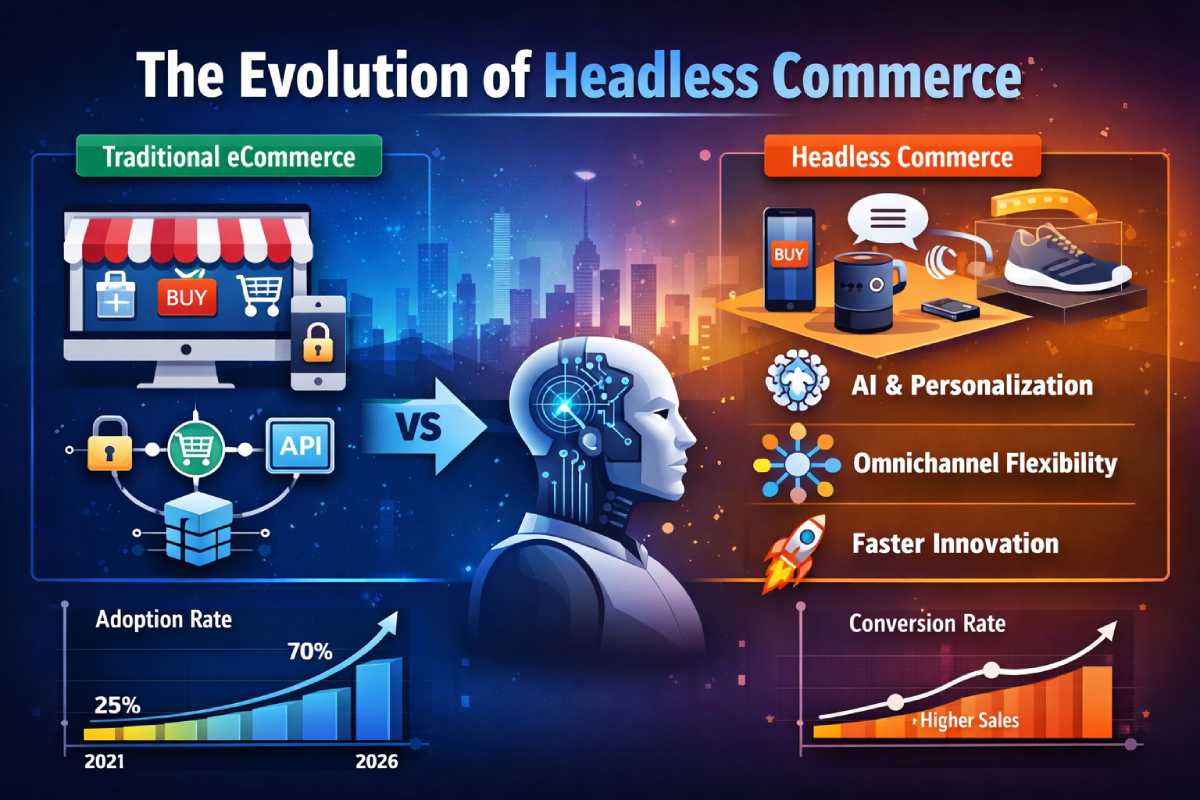
Headless Commerce: The benefits of headless commerce platforms changed the way businesses sell goods and services, and companies can look to autonomous commerce to continue that tradition by equipping businesses with new and creative front-end sales methods.
Table of Contents
Differences and Benefits of Headless Commerce vs Ecommerce
When eCommerce first started, businesses wanted an all-in-one platform that could help drive online sales from start to finish. It included digitizing back-end processes such as customer login and registration record keeping, product and order management. Payment processing and shipping costs, and tasks front-end, including pre-built website plugins and phone and chat integrations.
As e-commerce advanced, many web developers found that there weren’t many pre-packaged interface options. And because the front-end processes were tied to the back-end, there was no way to add new, unique, fully customizable methods for attracting and keeping customers. Also developers started asking for a way to completely decouple the front-end from the back-end of an eCommerce platform.
Companies should consider headless commerce as an evolutionary change in traditional e-commerce.
Headless Commerce vs Traditional eCommerce
| Feature | Headless Commerce | Traditional eCommerce |
| Architecture | Front-end and back-end are separate | Front-end and back-end are connected |
| Customization | Highly customizable | Limited customization |
| Development Speed | Faster innovation | Slower updates |
| Omnichannel Support | Supports multiple digital channels | Limited channel support |
| User Experience | Highly personalized | Standard experience |
Benefits Autonomous Trading Offers Over Legacy :
True omnichannel experience
While many traditional eCommerce stages claim to offer an omnichannel experience, that’s not essentially true. If a business wants to increase a new digital sales channel, also but the legacy benefits of headless commerce platform doesn’t offer it yet, they’re out of luck. Headless commerce allows a company’s developers to create an interface for a new digital sales channel whenever they want and without waiting. Considering advances in smart kiosks, interactive digital signage, and other forms of commerce-focused IoT,
Personalized Customer Experience of Headless Commerce
Organizations can adjust front-end sales to match customer tastes and preferences with an autonomous commerce platform. Businesses observing for ways to differentiate themselves from the competition need to personalize the initial online sales presentation experience. It includes adding personalized shopping preferences, personalized recommendations. And also targeted promotions to the customer based on past purchase history. The company selling the product or service and is also known to create more robust long-term customer retention rates.
Flexibility
delivery and pickup options, and the customer’s digital channels to purchase products or services. When the preferences of a company’s customer base change overnight, only an autonomous trading platform is flexible enough to change with them.
Higher Conversion Rates
An eCommerce platform can reduce the number of website bounces or shopping cart abandonment rates by instilling a sense of excitement about the products or services you sell. The whole purpose of headless commerce is to hand over the customization. Also lexibility and creativity to in-house developers so they can help create that excitement in unique ways, also like offering individualized promotions.
The Digital Experience Platform of Headless Commerce
Digital Experience Platforms (DXP) take over the role of Content Management Systems (CMS) and Web Experience Management (WEM) tools. Depending on your needs, you can choose to select a single DXP tool or build functionality using CMS and WEM.
CMS – Your content management system allows you to create and push Content, like products, to the front. Some sellers use Shopify or Salesforce Commerce for this. Others rely on no-code CMS like Content ful, Prismic, or Sanity. The CMS offers localized control from a single site unless you partner with the API or an iPaaS to push data to a central platform.
WEM
Web Experience Management is a crucial enterprise tool designed to deliver consistency and centralization.
DXP
DXP uses microservices architecture and API to combine web experience management and CMS in a single platform.
However, kentico Content is one of the largest headless content management systems, offering product management, front-end landing pages, user gateways, and performance analytics on almost any platform or stack.
Shogun
Shogun is a front-end eCommerce website builder designed to build headless front-ends for platforms like Shopify, Magento, and Big Commerce.
Crystallize offers product information management with rich workflows, pipelines, and content management across all platforms, with an open API to connect to (almost) any platform.
Back-End Databases
You are without head commerce will almost always include an ERP. However, it is likely to be the one you are familiar with. Whether it’s SAP, Adobe Commerce, Crystallize and also Commerce Layer, it’s up to you.
These tie in (and often overlap) with digital experience and iPaaS platforms, as many vendors, like Commerce Layer, try to offer an out-of-the-box solution for headless commerce.
Content Management of Headless Commerce
Here, eCommerce sellers have a wide variety of options, with Shopify, Salesforce Commerce, Commerce Layer, Big Commerce, Adobe Magento Commerce, and Oro Commerce all offering “headless” options for their commerce platforms.
Payment Processing
Most eCommerce sellers have already unlinked payments from their interface. By doing so, they free themselves from numerous security and also compliance regulations, such as PCI-DSS.
Security
If your eCommerce supplies allow user login, you need user organization and security. Also tools like Auth0, Cognito, and Akamai Character let you manage users and logins across sites for a seamless checkout and account experience.
Headless Commerce Types
Headless commerce is an e-commerce architecture that decouples the front end (user interface) from the back end (i.e., the user interface) from the back end (i.e., the commerce engine). This allows for more flexibility, scalability, and customisation in building online shopping experiences.
There are different types of headless commerce architectures that businesses can adopt, including:
API-First: This type of headless commerce involves building an API (Application Programming Interface) layer between the front and back end. The API handles all the data requests and responses between the two layers, enabling developers to create custom front-end experiences that integrate with any back-end system.

Hybrid: A hybrid headless commerce architecture that combines traditional e-commerce and headless commerce. In this model, the front-end and back-end are loosely coupled, but an e-commerce platform still provides the front end. The platform’s APIs are exposed to allow for customisation, but the platform still handles core functionality such as payments, inventory management, and order fulfilment.
Microservices: In a microservices-based headless commerce architecture, the commerce engine is broken down into more minor, independent services that can be individually customised and scaled. This allows for greater flexibility and agility in responding to changing business needs and customer demands.
Jamstack: Jamstack (JavaScript, APIs, and Markup) is a modern web development architecture emphasising performance, security, and scalability. In a Jamstack headless commerce architecture, the front end is built using static site generators, which can be served directly from a content delivery network (CDN). The back end is powered by APIs, which handle data and transaction processing.
These headless commerce architectures offer unique advantages and disadvantages depending on a business’s specific needs and goals.
Latest Headless Commerce Trends (2024–2026)
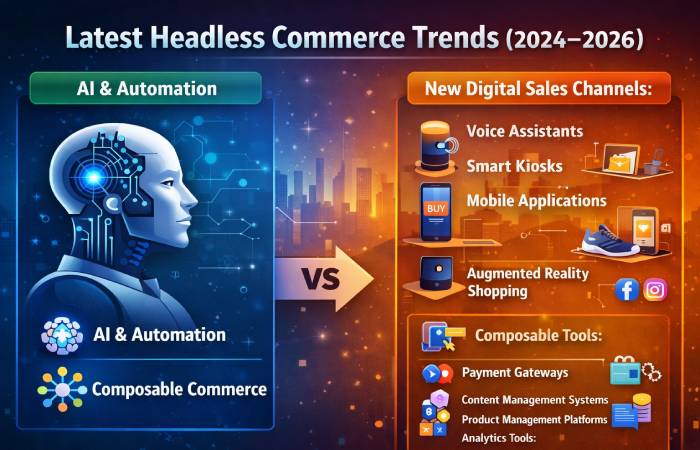
Headless commerce continues to evolve as businesses demand faster, more flexible digital commerce experiences. In recent years, companies have increasingly adopted headless architecture to support mobile shopping, voice commerce, and AI-driven personalization.
One of the biggest trends is the integration of AI and automation into headless platforms. Businesses now use artificial intelligence to provide product recommendations, dynamic pricing, and personalized shopping experiences.
Another emerging trend is composable commerce. Instead of using one large platform, businesses combine several specialized tools such as content management systems, payment gateways, product management platforms, and analytics tools.
Headless commerce is also enabling new digital sales channels such as:
- Voice assistants
- Smart kiosks
- Mobile applications
- Augmented reality shopping
- Social media commerce
Because the front-end is independent, businesses can launch these experiences quickly without rebuilding their entire eCommerce system.
Headless Commerce vs Monolithic Commerce Platforms
| Feature | Headless Commerce | Monolithic Commerce |
| Architecture | Decoupled front-end and back-end | Single integrated system |
| Flexibility | Very high | Limited |
| Customization | Fully customizable user experience | Restricted to templates |
| Development Speed | Faster deployment | Slower updates |
| Omnichannel Capability | Excellent support | Limited channels |
| Performance | Faster website performance | Can become slower with scale |
| Scalability | Highly scalable | Difficult to scale |
The decoupled architecture allows businesses to create a fully customizable user experience while keeping backend operations stable.
Popular Headless Commerce Platforms Comparison
| Platform | Best For | Key Features |
| Shopify Headless | Small to medium businesses | API-based commerce, fast deployment |
| Magento (Adobe Commerce) | Enterprise businesses | Advanced product management |
| BigCommerce | Growing online stores | Multi-channel integrations |
| Commerce Layer | API-first businesses | Fully flexible architecture |
| Crystallize | Content-driven commerce | Headless PIM + CMS |
Year-Wise Growth of Headless Commerce Adoption
| Year | Global Adoption Rate | Key Development |
| 2021 | 25% | Early enterprise adoption |
| 2022 | 33% | Growth in omnichannel commerce |
| 2023 | 41% | Rise of composable commerce |
| 2024 | 52% | AI integration in headless platforms |
| 2025 | 63% | Voice commerce and IoT channels |
| 2026 | 70%+ (projected) | AI-driven autonomous commerce |
This growth shows that many companies are shifting from traditional eCommerce platforms to headless systems to improve flexibility and digital experience.
Emerging Technologies in Headless Commerce
AI-Driven Personalization
Artificial intelligence analyzes customer behavior to recommend products, offers, and content in real time.
Businesses now use Artificial Intelligence to provide product recommendations, dynamic pricing, and personalized shopping experiences
Voice Commerce
Consumers can place orders through voice assistants such as smart speakers.
Augmented Reality Shopping
Customers can visualize products like furniture, clothing, or accessories before purchasing.
Composable Commerce
Businesses combine multiple microservices instead of relying on a single platform.
Key Metrics Businesses Improve With Headless Commerce
| Metric | Improvement with Headless |
| Page Load Speed | 30–50% faster |
| Conversion Rate | 20–40% increase |
| Cart Abandonment | Reduced significantly |
| Development Time | Faster deployment cycles |
| Customer Engagement | Higher personalization |
Future of Headless Commerce
The future of eCommerce is moving toward autonomous and composable commerce ecosystems. Businesses will increasingly rely on API-driven platforms, AI automation, and microservices architecture to deliver seamless shopping experiences across devices and channels.
Companies adopting headless commerce today gain the advantage of faster innovation, better scalability, and improved customer experiences. As digital commerce continues to evolve, headless architecture is expected to become the standard foundation for modern online retail systems.
Conclusion
Creating interactive customer experiences that result in discounts. Such as completing a quiz or a game on the website to receive deals and original recommendations. This eagerness often translates into increased conversion rates across all channels.