
Table of Contents
Introduction
Hiring the right employees has never been easy. Companies receive hundreds or even thousands of applications for a single job opening. Reviewing every resume, contacting candidates, scheduling interviews, and making hiring decisions can take weeks or even months.
Artificial intelligence (AI) is changing this process. AI recruiting software helps businesses reduce manual work, identify qualified candidates faster, and improve the overall hiring experience. Instead of replacing recruiters, AI supports them by handling repetitive tasks and providing useful insights based on data.
Today, organizations of all sizes use AI-powered recruitment tools to improve hiring speed and find better talent. Recruitment agencies also use these platforms to manage clients, organize candidate information, and improve placement success.
This guide explains what AI recruiting software is, how it works, its key features, benefits, challenges, current trends, and how businesses can choose the right solution.
AI Recruiting Software for Recruitment Agencies
Recruitment agencies manage multiple job openings and work with different clients at the same time. Finding the right candidate quickly is important for maintaining client satisfaction. AI recruiting software helps agencies organize their hiring process and reduce the time spent on manual tasks.
Instead of searching through hundreds of resumes one by one, recruiters can use AI to identify candidates whose skills and experience match the job requirements. This allows recruiters to spend more time communicating with candidates and clients rather than handling repetitive administrative work.
AI recruiting software also helps agencies build a stronger talent database. Candidate profiles are stored in one place, making it easier to search for suitable applicants when new positions become available. Many platforms can also identify previous applicants who may be a good fit for future openings.
Another advantage is better communication. Automated email updates, interview reminders, and follow-up messages help candidates stay informed throughout the recruitment process. This creates a more professional experience and improves engagement.
For recruitment agencies handling large hiring projects, AI software provides useful reports such as time-to-fill, recruiter performance, source of hire, and candidate conversion rates. These insights help agencies improve their recruitment strategies and deliver better results for clients.
How Recruitment Agencies Benefit from AI
| Benefit | How It Helps |
| Faster Candidate Search | Finds qualified candidates in less time. |
| Better Candidate Matching | Matches applicants based on skills and experience. |
| Resume Screening | Reviews large numbers of resumes automatically. |
| Automated Communication | Sends interview invitations and follow-up emails. |
| Talent Database | Stores candidate information for future hiring. |
| Recruitment Analytics | Tracks hiring performance and identifies areas for improvement. |
| Improved Client Service | Delivers qualified candidates more quickly. |
By combining recruiter expertise with AI-powered tools, recruitment agencies can improve productivity, reduce hiring delays, and provide a better experience for both clients and job seekers.
What Is AI Recruiting Software?
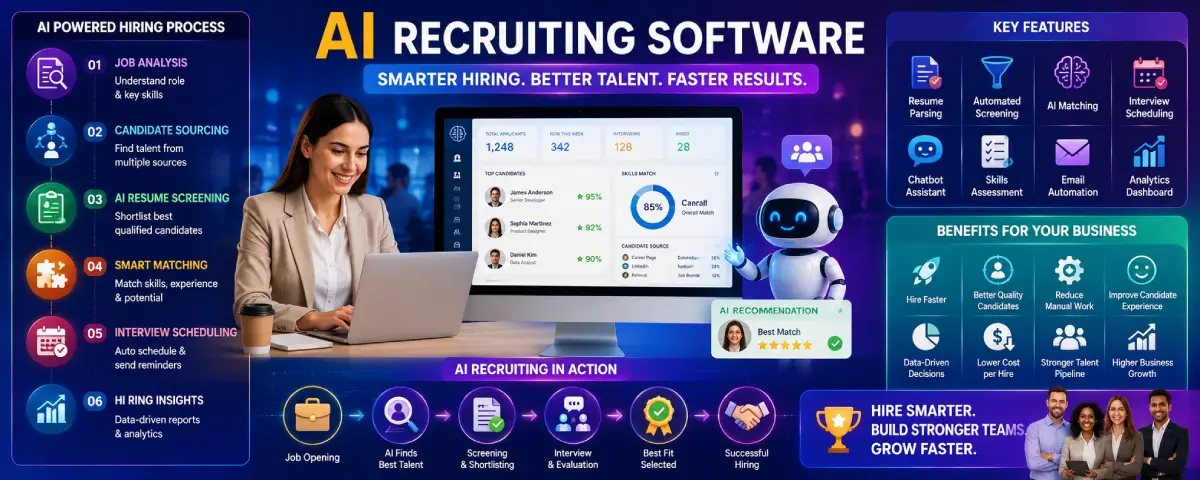
AI recruiting software is a hiring solution that uses artificial intelligence, machine learning, and automation to support different stages of recruitment. It helps recruiters complete routine tasks more quickly while improving decision-making with data-driven insights.
Instead of manually reviewing every application, recruiters can use AI to identify candidates who match the required skills, qualifications, and experience.
Modern AI recruiting platforms often work alongside Applicant Tracking Systems (ATS), Human Resource Management Systems (HRMS), and Customer Relationship Management (CRM) software.
Many organizations also integrate recruitment platforms with their broader marketing and sales technology ecosystem. Learn more in our Marketing Stack Guide.
The main goal is to make hiring faster, more accurate, and more organized.
Quick Overview
| Feature | Description |
| Primary Purpose | Improve recruitment efficiency |
| Technology Used | Artificial Intelligence, Machine Learning, Natural Language Processing |
| Users | Companies, HR teams, recruitment agencies |
| Main Benefit | Faster and more accurate hiring |
| Common Integration | ATS, HR software, CRM systems |
How AI Recruiting Software Works
AI recruiting software follows several steps during the hiring process.
Job Description Analysis
The software reviews the job description and identifies important skills, qualifications, certifications, and experience required for the role.
It can also suggest better wording to make job advertisements clearer and more attractive.
Candidate Sourcing
The platform searches different sources for suitable candidates.
These sources may include:
- Company career pages
- Resume databases
- Professional networking websites
- Job boards
- Employee referral programs
- Internal talent databases
Instead of searching manually, recruiters receive a list of potential candidates within minutes.
Resume Screening
One of the biggest advantages of AI recruiting software is resume screening.
The system compares resumes with job requirements by checking factors such as:
- Skills
- Work experience
- Education
- Certifications
- Technical knowledge
- Industry experience
Candidates who closely match the position are ranked higher.
Candidate Matching
AI evaluates how well each applicant matches the job requirements.
Rather than looking only at keywords, many modern platforms analyze:
- Skill combinations
- Career growth
- Relevant experience
- Project history
- Learning ability
This helps recruiters focus on candidates who are more likely to succeed.
Interview Scheduling
Many AI recruitment platforms automatically schedule interviews.
The software checks recruiter availability and candidate availability before sending invitations.
Automatic reminders reduce missed interviews and save administrative time.
Communication Automation
AI chatbots can answer common questions from applicants.
Examples include:
- Application status
- Interview timing
- Required documents
- Company policies
- Recruitment process
This improves the candidate experience while reducing recruiter workload.
Hiring Analytics
AI recruiting software also provides reports that help companies improve hiring performance.
Common hiring metrics include:
- Time to hire
- Cost per hire
- Source of hire
- Offer acceptance rate
- Candidate conversion rate
- Recruitment pipeline performance
These reports help HR teams make better hiring decisions.
Main Features of AI Recruiting Software
Different platforms offer different capabilities, but most modern solutions include the following features.
| Feature | Purpose |
| Resume Parsing | Reads and organizes resumes automatically |
| Candidate Matching | Matches applicants to job requirements |
| Automated Screening | Filters qualified candidates |
| Interview Scheduling | Books interviews automatically |
| AI Chatbots | Answers candidate questions |
| Skills Assessment | Evaluates technical and soft skills |
| Analytics Dashboard | Tracks hiring performance |
| ATS Integration | Connects with existing recruitment software |
| Email Automation | Sends interview and follow-up emails |
| Talent Pool Management | Stores candidate profiles for future hiring |
Benefits of AI Recruiting Software
Organizations across different industries use AI recruiting software because it improves both efficiency and hiring quality.
Faster Hiring
Manual resume screening often takes several days.
AI completes the same task in minutes.
This reduces hiring delays and helps businesses fill important positions more quickly.
Better Candidate Matching
AI analyzes multiple factors instead of relying only on keywords.
This often produces more accurate candidate recommendations.
Improved Recruiter Productivity
Recruiters spend less time on repetitive administrative work.
Instead, they can focus on interviewing candidates, building relationships, and making better hiring decisions.
Better Candidate Experience
Applicants receive faster updates, interview reminders, and timely communication.
This creates a more professional hiring experience.
Reduced Manual Errors
Automation helps reduce mistakes such as:
- Missing qualified candidates
- Duplicate records
- Scheduling conflicts
- Data entry errors
Better Recruitment Planning
Hiring reports allow HR teams to identify problems in the recruitment process and improve future hiring strategies.
Traditional Recruitment vs AI Recruiting Software
| Traditional Recruitment | AI Recruiting Software |
| Manual resume review | Automated resume screening |
| Time-consuming sourcing | AI-powered candidate search |
| Manual interview scheduling | Automatic scheduling |
| Limited hiring analytics | Real-time recruitment reports |
| Higher administrative workload | Greater automation |
| Slower hiring process | Faster recruitment cycle |
Why AI Recruiting Matters in 2026
The hiring market has become more competitive than ever.
Companies are searching for skilled professionals across different locations, including remote and hybrid workplaces.
AI helps recruiters manage larger applicant pools while improving hiring quality.
Recent developments have also introduced AI tools that assist with writing job descriptions, summarizing interviews, identifying skill gaps, and improving workforce planning. As these capabilities continue to evolve, organizations are using AI not only to speed up recruitment but also to support better long-term talent strategies.