
Table of Contents
Introduction
Technology is growing very fast. Every day, we use apps, websites, smart devices, and online services. All these systems depend on data.
Traditionally, this data is sent to big central servers called cloud data centers. But today, this method is slowly changing.
A new concept called edge computing is becoming popular.
In simple words, edge computing means processing data closer to where it is created instead of sending it far away to a central server. According to IBM, edge computing processes data near the source to improve speed and reduce latency.
This small change makes a big difference in speed, performance, and efficiency.
What is Edge Computing?
Edge computing is a method where data is processed near the device instead of a distant server.
For example:
- A smart camera processes video locally
- A mobile app responds instantly without waiting for cloud servers
- A smart car reacts immediately to road conditions
Instead of sending all data to the cloud, some work is done nearby.
What is Edge Computing in Real Life?
- ATM machines processing data
- Google Maps working fast
- Face unlock in phones
Why Edge Computing is Important Today
Today, we use:
- Smartphones
- Smart TVs
- IoT devices
- Online apps
All these generate huge amounts of data.
If all this data goes to the cloud, it creates:
- Delay (slow response)
- Network overload
- Higher costs
Edge computing solves these problems by processing data locally. Experts at Microsoft explain that edge computing reduces latency and improves performance for real-time applications.
How Edge Computing Works
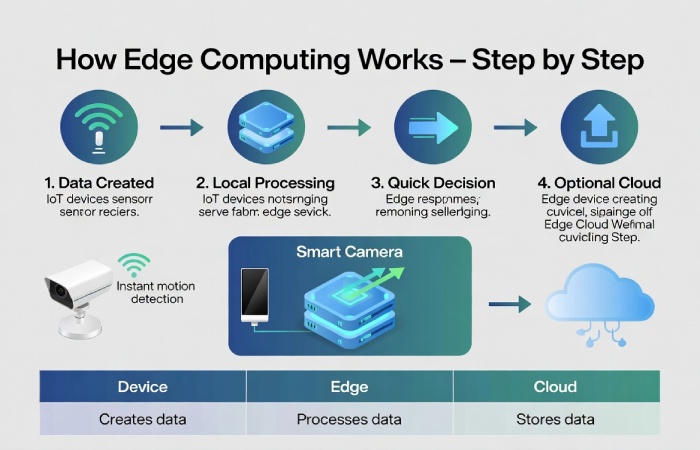
Let’s understand this step by step.
Step 1: Data is Created
Devices like phones, sensors, or cameras generate data.
Step 2: Local Processing
Instead of sending data to the cloud, it is processed nearby.
Step 3: Quick Decision
The system reacts instantly.
Step 4: Optional Cloud Storage
Only important data is sent to the cloud.
Simple Example
Imagine you are using a smart security camera.
Edge Computing Architecture (Simple)
Explain in simple flow:
Device → Edge Node → Cloud
Add a small table:
| Layer | Role |
| Device | Creates data |
| Edge | Processes data |
| Cloud | Stores data |
Without Edge Computing:
- Video is sent to cloud
- Cloud processes it
- Response comes back
- Time delay happens
With Edge Computing:
- Camera processes video locally
- Detects movement instantly
- Sends alert immediately
Faster and more efficient
Edge Computing vs Cloud Computing
| Feature | Edge Computing | Cloud Computing |
| Data Processing | Near device | Central server |
| Speed | Very fast | Slower |
| Internet Dependency | Low | High |
| Cost | Lower long term | Higher |
| Data Transfer | Less | More |
Where Edge Computing is Used
Edge computing is used in many real-life situations.
- Smart Homes
Devices like smart lights and cameras respond instantly.
- Healthcare
Wearable devices track health in real time.
- Self-Driving Cars
Cars process data instantly to avoid accidents.
- Online Gaming
Reduces lag and improves performance.
- Retail Stores
Smart systems track customer behavior.
Benefits of Edge Computing
- Faster Speed
Data is processed locally, so response time is very fast.
- Reduced Internet Usage
Less data is sent to cloud servers.
- Better Performance
Apps and devices work smoothly.
- Improved Privacy
Sensitive data stays closer to the user.
- Lower Costs
Less cloud storage and bandwidth required.
Edge Computing Use Cases by Industry
| Industry | Example |
| Healthcare | Health monitoring |
| Retail | Smart billing |
| Transport | Traffic control |
| Manufacturing | Machine automation |
Challenges of Edge Computing
- Setup Cost
Initial setup can be expensive.
- Maintenance
Managing many local devices can be difficult.
- Security Risks
More devices mean more entry points for attacks.
Common Mistakes in Edge Computing
- Using it without need
- Ignoring security
- Poor device management
- No backup system
Edge Computing in Daily Life
You may already be using edge computing without knowing.
Examples:
- Face unlock on your phone
- Voice assistants responding instantly
- Smart watches tracking health
These features work quickly because of local processing.
Latest Trends in Edge Computing (2026)
Edge computing is growing fast.
Key trends:
- Integration with AI
- Use in 5G networks
- Smart cities development
- Real-time analytics
- Industrial automation
Edge Computing + AI (Powerful Combination)
When edge computing is combined with AI:
- Devices become smarter
- Decisions are faster
- Automation improves
Example:
A smart camera can detect faces without sending data to cloud.
Edge Computing vs Fog Computing
| Feature | Edge Computing | Fog Computing |
| Processing Location | Very close to device | Between cloud and device |
| Speed | Faster | Moderate |
| Complexity | Simple | More complex |
When to Use Edge Computing
Use edge computing when:
- You need fast response
- Internet is slow
- Real-time decisions are required
- Data privacy is important
Common Mistakes People Make
- Thinking edge computing replaces cloud
- Ignoring security risks
- Using it without proper planning
Edge and cloud work together, not separately
Future of Edge Computing
Edge computing will play a major role in future technology.
Expected growth areas:
- Smart cities
- Autonomous vehicles
- Healthcare systems
- Industrial automation
More devices will become intelligent and independent.
Real Examples of Edge Computing in 2026
- Smart traffic systems
- AI security cameras
- Smart factories
- 5G networks
Edge Computing vs Cloud vs IoT
| Feature | Edge | Cloud | IoT |
| Speed | Fast | Medium | Depends |
| Data Location | Near | Far | Device |
| Use | Real-time | Storage | Data collection |
Practical Insight
From real experience, edge computing is not just a technical concept. It is already part of daily life.
Whenever a device responds instantly, it is likely using edge computing.
Instead of waiting for data to travel long distances, systems are becoming faster and smarter by working locally.
When Should You Use Edge Computing?
- Need fast response
- Low internet speed
- Real-time apps
- Privacy important
Frequently Asked Questions
What is edge computing in simple words?
It means processing data near the device instead of sending it far away.
Is edge computing better than cloud?
Both are useful. Edge is faster, cloud is powerful for storage.
Where is edge computing used?
Smart homes, healthcare, cars, gaming, and more.
Conclusion
Edge computing is changing how technology works.
Instead of depending fully on distant servers, devices are becoming smarter and faster by processing data locally.
This improves speed, reduces cost, and creates better user experience.
As technology grows, edge computing will become even more important in everyday life.