


Cloud computing is to different types of hosting services provided through a network over the Internet. The advantage of cloud computing for businesses is the flexibility and versatility it has to adapt to your business’s unique needs and requirements. Cloud computing services typically include access to servers, databases, networking software, analytics, and other computing functions and applications.
Table of Contents
What Cloud Computing Includes
| Cloud Service | What It Does | Why Business Uses It |
|---|---|---|
| Servers | Stores and runs applications | No need to buy hardware |
| Databases | Stores customer & business data | Easy data management |
| Networking | Connects systems and users | Smooth communication |
| Analytics | Data analysis tools | Better decisions |
| Storage | Saves files & backups | Secure remote access |
Many companies have started to adopt cloud computing because it reduces the need for physical hardware such as hard drives, USB drives, or physical servers. It saves costs and storage space and allows users to access computing resources, files, applications, servers, data storage, etc., on-demand, anywhere and at any time. Cloud-based services offer more climbable, agile, flexible, and reliable computing infrastructures that improve the performance and growth of companies, as offered by these solutions:
Cloud Computing
On-demand self-service – This has self -a service that allows end-users to access applications, data, analytics, etc., on their own, thereby eliminating the need for IT administrators to manage these functions. It also improves the customer experience.
Extensive network access – this solution allows users to connect to the cloud at any time and with any device, as long as they have an Internet connection.
Pooling of Resources
Cloud providers serve numerous customers using the same physical resources, often making it a more cost-effective solution.
Rapid Elasticity
The rapid elasticity capacity of allows for greater scalability. Companies can scale up or down, contingent on their requirements or growth needs.
Metered Service – Resources are generally metering on a pay-per-use or pay-per-use basis. It allows you to pay only for the resources and workloads you use.
Companies can scale up or down, contingent on their requirements or growth needs
Percentage Growth Table
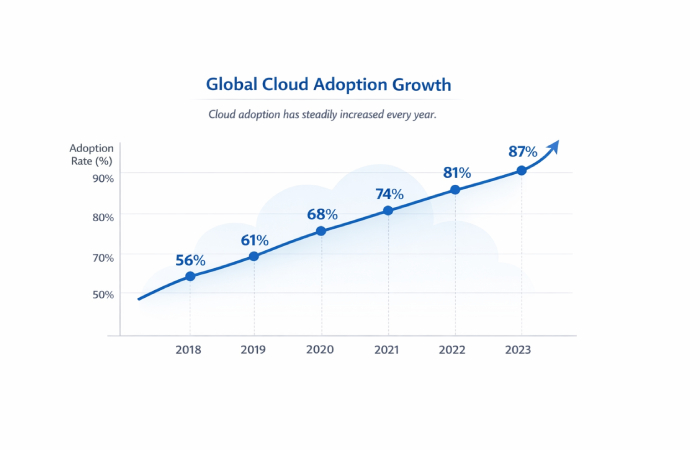
| Year | Global Cloud Adoption (%) |
|---|---|
| 2018 | 56% |
| 2019 | 61% |
| 2020 | 68% |
| 2021 | 74% |
| 2022 | 81% |
| 2023 | 87% |
Cloud adoption has steadily increased every year as more businesses move to digital infrastructure.
Cloud Adoption Growth
Cloud Computing Model
There are three exact cloud computing models on the market ;
Software as a Service (SaaS)
This is the most popular and widely used. The software or claims are hosted in the cloud, where users can access them through web browsers and mobile applications. Or an API (application program interface) integrates with a desktop, mobile device, or operating system. . This type of service is usually paid monthly or on a pay-per-use basis. Infrastructure as a Service (IaaS): This is the most open cloud service that provides access to physical and virtual services and networks and storage over the Internet, anywhere and anytime. This service is scalable, providing additional capacity to be accessed on-demand based on business needs. Typically, users access this self-service platform via a dashboard or an Application Program Interface (API).
Platform as a Service (PaaS)
This is primarily a cloud environment that supports the development and deployment of web applications. This platform provides the hardware, software, organization, and also product tools to run, develop, and manage applications without the complexity and cost of maintaining a local medium.
| Feature | SaaS | IaaS | PaaS |
|---|---|---|---|
| Setup Needed | No | Yes | Moderate |
| Technical Skills | Low | High | Medium |
| Control Level | Low | Full | Partial |
| Best For | Small businesses | IT teams | Developers |
| Payment | Monthly | Pay-as-you-go | Subscription |
Types Of Cloud Computing
With the features that make it possible and the three main service models, we still need to answer the question: how does it work?
However, all cloud applications have a host, often called a cloud service provider (CSP). A CSP is responsible for maintaining data centres that securely store and maintain essential business data and information. These hosts sell end-users and businesses the right to use their cloud services and data storage on their networks.
-
Amazon Web Services
-
Microsoft Azure
-
Google Cloud
| Provider | Founded | Known For |
|---|---|---|
| Amazon Web Services | 2006 | Largest cloud provider |
| Microsoft Azure | 2010 | Enterprise integration |
| Google Cloud | 2011 | Data & AI services |
Public vs Private vs Hybrid Comparison
| Feature | Public Cloud | Private Cloud | Hybrid Cloud |
|---|---|---|---|
| Cost | Low | High | Medium |
| Control | Limited | Full | Flexible |
| Security | Standard | High | High |
| Best For | Startups | Large enterprises | Growing companies |
| Maintenance | Provider handles | Company handles | Shared |
There Are Three Types Of Cloud Computing Representations
Public Cloud Computing
With this type of cloud computing, CSPs make properties available to users over the public Internet. In this case, the public worker owns, manages, and takes full responsibility for the data centre hardware and computing infrastructure. It typically provides high-bandwidth network connectivity to improve performance and quickly access applications and data. These services are sold on demand, and customers only pay for the storage or bandwidth they use.
Private Cloud Computing
Computing properties are dedicated to the business, meaning companies can build and manage their own data centre and also cloud infrastructure. Private cloud services are typically host on an independent provider’s infrastructure or built on lease infrastructure.
Cross-Cloud Computing
It is a combination of private and public cloud solutions. This model combines different aspects of private and public cloud services to provide more flexibility. Also hybrid cloud model allows companies to find the optimal cloud infrastructure for various applications or workloads.
The decision of what type of infrastructure to use depends mainly on a company’s unique needs, workloads, applications, etc. There are several benefits of Cloud Computing that are apparent regardless of which type is chosen, which we explore below.
Benefits, Challenges
Cloud computing is being used to improve business operations and processes, and its benefits
Always-Available Storage
Cloud computing offers always-available storage, which also means you can, no matter where you are or what device you’re using if you need to access your information.
Disaster Recovery and Business Continuity Solutions
However, disaster recovery solutions are often expensive, complex and time-consuming. A cloud solution is more reliable, easier, and also more efficient to set up and maintain. The way the cloud tech is design also ensures that your data is backup and instantly accessible if a server fails, reducing downtime and improving business continuity and productivity.
Cost savings
one of the main benefits of cloud computing is the reduction of IT operating costs. Services are often more cost-effective since you only pay for what you use. You also save on storage, application and maintenance costs, as the servers are host remotely.
Cloud Benefit Impact (Estimated %)
Cost Savings ████████████ 35%
Scalability ███████████████ 45%
Security Improvement ██████████ 30%
Collaboration ███████████ 38%
Performance Boost █████████████ 42%
Cloud Cost Savings Table
| Cost Area | Average Savings (%) |
|---|---|
| Hardware | 30–40% |
| Maintenance | 25–35% |
| IT Staff | 20–30% |
| Data Backup | 35–45% |
You can add one line:
Studies show businesses save up to 30–40% in infrastructure costs after moving to cloud services.
Constant Updates
CSPs take responsibility for system updates, also ensuring effective maintenance of cloud services and security updates.
Improved Collaboration
Cloud computing makes it easier for employees to work together, especially in different locations. The ability to access information remotely and also collaborate as a team streamlines work processes and improves productivity.
Remote Work Productivity Table
| Factor | Before Cloud | After Cloud |
|---|---|---|
| File Sharing Speed | Slow | Instant |
| Team Collaboration | Limited | Real-time |
| Remote Access | Difficult | Easy |
| Productivity | Moderate | Higher |
Increased Capacity and Performance
Cloud computing is scalable and can adapt to the changing needs of your business. Also a company grows, the requirements for storage space, bandwidth, etc., change.
Conclusion
A solution allows you to scale up or down efficiently based on these need, Also secure as security protocols and infrastructure are continuously monitor, analyze and update to protect your data from threats.
Also Read: Teach