
Table of Contents
Introduction
Artificial Intelligence is growing fast, as explained in recent AI industry reports, and new advancements like Autonomous AI are gaining attention— Autonomous AI. Many businesses, developers, and even normal users are starting to hear about it. But still, most people don’t clearly understand what it means..
In simple words, Autonomous AI is not just a tool that follows commands. It is a system that can think, decide, and act on its own without constant human input.
This is why companies are investing heavily in it. From self-driving cars to smart business automation, Autonomous AI is becoming the next big shift after basic AI tools.
In this article, we will understand what Autonomous AI is, how it works, its types, real-world use cases, benefits, risks, and future trends in simple language.
What is Autonomous AI?
Autonomous AI is a type of artificial intelligence that can perform tasks independently. It does not need step-by-step instructions from humans.
Traditional AI works like this:
- You give input
- It gives output
But Autonomous AI works like this:
- It understands the goal
- It plans actions
- It executes tasks
- It learns from results
So, it behaves more like a human decision-maker rather than a simple machine.
Simple Definition
Autonomous AI is an AI system that can make decisions, take actions, and improve itself without human control.
Key Features of Autonomous AI
Here are the main features that make it different:
- Self-decision making
- Goal-oriented behavior
- Continuous learning
- Real-time adaptation
- Minimal human involvement
How Autonomous AI Works
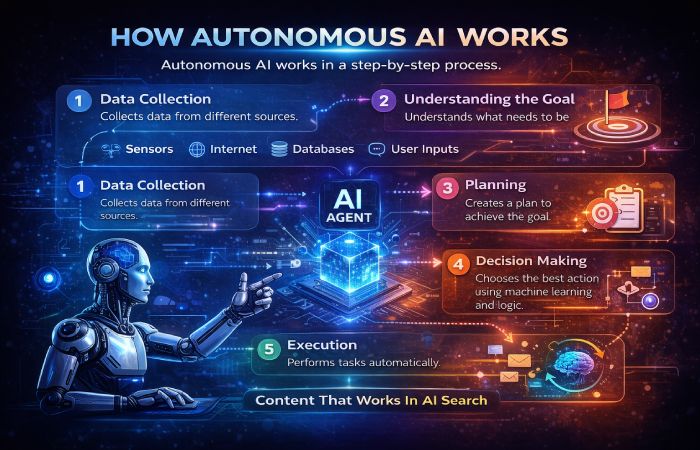
Autonomous AI works in a step-by-step process. Let’s understand it simply.
- Data Collection
First, it collects data from different sources:
- Sensors
- Internet
- Databases
- User inputs
This data is the base for decision-making.
- Understanding the Goal
Instead of waiting for instructions, it understands what needs to be done.
Example:
If the goal is “increase website traffic,” it will plan actions like SEO, content, ads, etc.
- Planning
It creates a plan to achieve the goal.
It decides:
- What steps to take
- Which tools to use
- What order to follow
- Decision Making
Using machine learning and logic, it chooses the best action.
- Execution
It performs tasks automatically.
Example:
- Posting content
- Sending emails
- Adjusting ads
- Learning and Improving
After execution, it checks results and improves.
This is called feedback loop learning.
Autonomous AI vs Traditional AI
Here is a simple comparison:
| Feature | Traditional AI | Autonomous AI |
| Control | Human controlled | Self-controlled |
| Decision making | Limited | Advanced |
| Learning | Basic | Continuous |
| Task execution | Manual trigger | Automatic |
| Flexibility | Low | High |
| Example | Chatbot replies | AI agents running full campaigns |
Types of Autonomous AI
There are different types based on usage:
- Reactive Autonomous AI
- Responds to current data only
- No memory
- Example: Simple robots
- Limited Memory AI
- Uses past data for decisions
- Common in business tools
- Goal-Based AI
- Focuses on achieving specific goals
- Used in automation systems
- Learning Autonomous AI
- Improves over time
- Uses machine learning
Real-World Examples of Autonomous AI
Autonomous AI is already being used in many areas:
- Self-Driving Cars
Cars can drive without human input using sensors and AI models.
- AI Agents for Business
AI tools can:
- Manage emails
- Handle customer support
- Run marketing campaigns
- Stock Trading Systems
AI can analyze market data and make trading decisions automatically.
- Healthcare Systems
AI helps in:
- Diagnosis
- Treatment planning
- Monitoring patients
- Smart Assistants
Advanced assistants can perform tasks without asking repeatedly.
Benefits of Autonomous AI
Here are the main advantages:
- Saves Time
Tasks are completed automatically.
- Reduces Human Effort
No need for constant supervision.
- Better Decision Making
Uses data, not emotions.
- Works 24/7
No breaks, no delays.
- Scalable
Can handle large tasks easily.
Challenges and Risks
Even though it is powerful, there are some risks:
- Lack of Control
Too much automation can be risky.
- Security Issues
If hacked, it can cause damage.
- Job Impact
Some jobs may reduce.
- Bias in Decisions
If data is biased, results can be wrong.
Autonomous AI vs Generative AI
People often confuse these two. Here is a clear difference:
| Feature | Autonomous AI | Generative AI |
| Purpose | Perform tasks independently | Create content |
| Example | AI agents | Text/image generation tools |
| Control | Self-directed | User-directed |
| Output | Actions | Content |
Latest Trends in Autonomous AI (2026)
Autonomous AI is growing fast. Here are some latest trends:
- AI Agents
AI agents are becoming popular. They can complete full tasks like:
- Writing blogs
- Publishing content
- Managing websites
- Multi-Agent Systems
Multiple AI systems work together to solve problems.
- Integration with Business Tools
AI is being connected with:
- CRM software
- Marketing tools
- Finance systems
- Real-Time Decision Systems
AI can make decisions instantly using live data.
- Autonomous Coding
AI can now:
- Write code
- Fix bugs
- Deploy applications
Use Cases for Businesses
Autonomous AI can help businesses in many ways:
- Content automation
- SEO optimization
- Customer support
- Sales automation
- Data analysis
When Should You Use Autonomous AI?
It is best to use Autonomous AI when:
- You want to automate repetitive tasks
- You need faster decision-making
- You handle large amounts of data
- You want to scale your business
When Not to Use It
Avoid using it when:
- Human judgment is very important
- Data is limited or poor
- Security is critical
Future of Autonomous AI
Autonomous AI will become more advanced in the coming years.
Expected changes:
- More human-like decision-making
- Better accuracy
- Safer systems
- Wider business adoption
It may become a core part of:
- Digital marketing
- Healthcare
- Finance
- Education
Conclusion
Autonomous AI is not just another technology trend. It is a major shift in how machines work.
Instead of just helping humans, it can now act on its own. This makes it powerful, but also something that needs careful use.
For businesses and individuals, understanding Autonomous AI early can give a strong advantage.
As technology grows, those who adapt quickly will benefit the most.