
Table of Contents
Introduction
Search is changing fast.
Earlier, people used Google to search for information. They typed a query, saw a list of websites, and clicked one by one to find answers.
Now, things are different.
Today, AI tools like ChatGPT, Gemini, and other AI assistants give direct answers instead of just links. Users don’t always visit websites anymore.
AI tools like ChatGPT, Gemini, and other AI assistants give direct answers instead of just links. According to industry insights from Google, AI-powered search is changing how users find information.
This change is very important for businesses.
If your business depends on website traffic, leads, or online visibility, then you must understand how AI search is different from Google search.
In this article, we will explain everything in simple words.
What is Google Search?
Google search is a traditional search engine.
When you search something like:
“best laptops under 50000”
Google shows:
- A list of websites
- Ads
- Featured snippets
- Videos
- Product listings
You click links and visit websites to get full information.
How Google Search Works
Google uses:
- Keywords
- Backlinks
- Content quality
- Website authority
- SEO optimization
Websites that follow SEO rules rank higher.
What is AI Search?
AI search works differently.
Instead of showing links, AI gives a direct answer in one place.
Example:
If you ask:
“Which is the best laptop under 50000?”
AI will:
- Understand your question
- Compare options
- Give a clear answer
You don’t need to visit multiple websites.
Why AI Search is Growing Fast
There are some clear reasons:
- Faster answers
Users don’t want to read 10 pages. They want one clear answer.
- Better understanding
AI understands natural language, not just keywords.
- Conversational experience
You can ask follow-up questions easily.
- Personalized results
AI can adjust answers based on user intent.
AI Search vs Google Search – Comparison
| Feature | Google Search | AI Search |
| Results | List of links | Direct answers |
| User effort | High (click & read) | Low (instant info) |
| SEO importance | Very high | Changing |
| Traffic to websites | High | Lower |
| Personalization | Limited | High |
| Speed | Medium | Fast |
| Content style needed | Keyword-focused | Intent-focused |
Biggest Impact on Businesses
This shift is not small.
It is a major change in digital marketing.
- Traffic may decrease
Earlier:
User → Google → Website
Now:
User → AI → Answer
Your website may not get clicks.
- Brand visibility becomes important
Even if users don’t click, AI may mention your brand.
So, businesses must focus on:
- Authority
- Trust
- Mentions
- Content strategy must change
Old SEO:
- Keyword stuffing
- Long blogs
- Backlinks only
New approach:
- Helpful answers
- Clear structure
- Real value
What Type of Content Works in AI Search
To rank in AI search, your content must be:
Clear and simple
Avoid complex language.
Write like you are explaining to a beginner.
Short sentences work better than long paragraphs.
Direct answers
Answer the main question quickly.
Do not delay the answer with long introductions.
Give value in the first few lines.
Well-structured
Use:
- Headings
- Bullet points
- Tables
This helps AI understand your content easily.
Trustworthy
Include:
- Real facts
- Examples
- Updated information
Content that looks reliable has a higher chance of being used by AI.
Covers full intent
Do not answer only one small part.
Example:
If the topic is “best laptops under 50000”, also include:
- Battery life
- Performance
- Use case (students, gaming, office)
AI prefers complete answers.
Updated content
Old content may not work well.
Update your articles with:
- Latest data
- New trends
- Current year (2026)
Fresh content is more useful.
Question-based format
Write content in a question-answer format.
Example:
- What is AI search?
- How does it work?
- Is it better than Google?
This matches how users ask questions in AI tools.
Use examples
Examples make your content easier to understand.
Instead of only theory, show real situations.
Add comparisons
AI prefers content that compares options.
Example:
- AI Search vs Google Search
- Free tools vs Paid tools
This helps users make decisions quickly.
Include lists
Lists are easy to read and easy for AI to pick.
Example:
- Top tools
- Best apps
- Key features
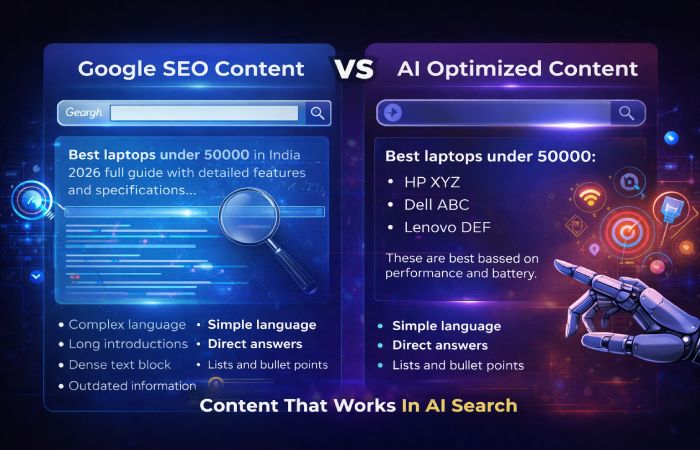
Example: Old vs New Content Style
Old style (Google SEO)
“Best laptops under 50000 in India 2026 full guide with detailed features and specifications…”
- Long introduction
- Too much explanation
- Answer comes late
New style (AI Search friendly)
“Best laptops under 50000:
- HP XYZ
- Dell ABC
- Lenovo DEF
These are best based on performance, battery, and price.”
- Quick answer
- Easy to scan
- Clear structure
One More Example
Old Content
“What is digital marketing and why it is important for businesses in today’s world…”
Long paragraph before answer.
New Content
“What is digital marketing?
Digital marketing means promoting products using online platforms like Google, social media, and websites.”
Short and clear.
Best Tip
If your content is:
- Easy to read
- Straight to the point
- Helpful
Then both AI and Google will prefer it.
What is GEO (Generative Engine Optimization)?
A new concept is growing: GEO
It means:
Optimizing your content for AI engines, not just search engines.
GEO focuses on:
- Answer quality
- Context understanding
- Structured content
- Authority signals
SEO vs GEO (Simple Difference)
| SEO | GEO |
| Focus on Google ranking | Focus on AI answers |
| Keywords important | Meaning important |
| Backlinks matter | Authority matters |
| Clicks goal | Mentions goal |
How Businesses Should Adapt (Step-by-Step)
Step 1: Update old content
Your website already has content.
Update it with:
- Latest data
- Clear answers
- Better headings
Step 2: Focus on user intent
Ask:
What does the user really want?
Not just keywords.
Step 3: Use FAQ sections
AI loves FAQ content.
Example:
- What is AI search?
- How does it work?
Step 4: Build authority
Write:
- Expert content
- Case studies
- Real experiences
Step 5: Improve brand presence
Be visible on:
- Blogs
- Social media
- Forums
AI picks information from multiple sources.
Real Example
Before
User searches:
“how to lose weight”
Google:
- Shows blogs
- User reads many pages
Now
User asks AI:
“how to lose weight fast?”
AI:
- Gives diet tips
- Workout plan
- Quick answer
User may never visit a website.
Challenges of AI Search
AI search is powerful but has some issues:
- Less traffic for websites
This is a big concern.
- Accuracy problems
Sometimes AI gives wrong answers.
- Less control
Businesses cannot fully control AI output.
Opportunities for Businesses
Even with challenges, there are big opportunities:
- Early advantage
Few businesses are optimizing for AI.
- Brand mentions
If AI mentions your brand, trust increases.
- New traffic sources
AI tools themselves may become traffic sources.
Future of Search (2026 and Beyond)
Search will not disappear.
But it will change.
Future trends:
- AI + search combination
- Voice search growth
- Personalized answers
- Less dependency on links
Businesses must adapt early.
Which is Better: AI Search or Google Search?
There is no single answer.
Google Search is better for:
- Deep research
- Multiple opinions
- Detailed reading
AI Search is better for:
- Quick answers
- Simple queries
- Time-saving
Final Conclusion
Search is evolving.
Google search is still important, but AI search is growing very fast.
Businesses that depend only on old SEO methods may struggle in the future.
To stay ahead:
- Focus on helpful content
- Write for humans, not just keywords
- Build authority and trust
- Start adapting to AI search now
This is not just a trend.
It is the future of digital visibility.