
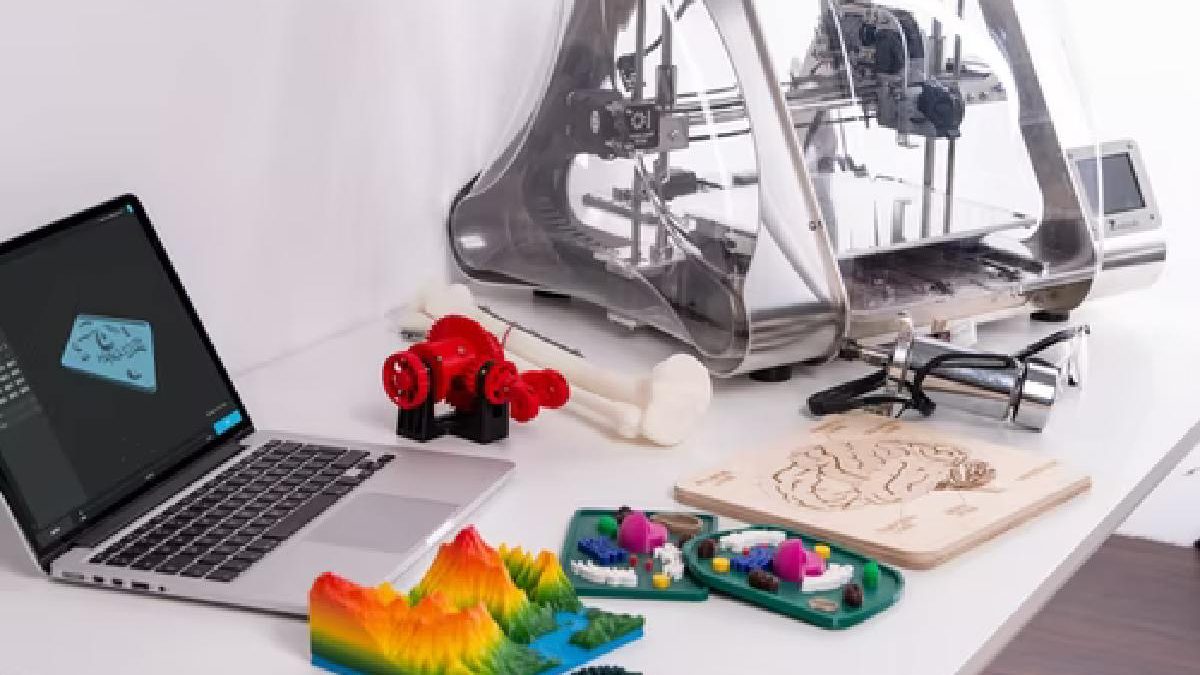
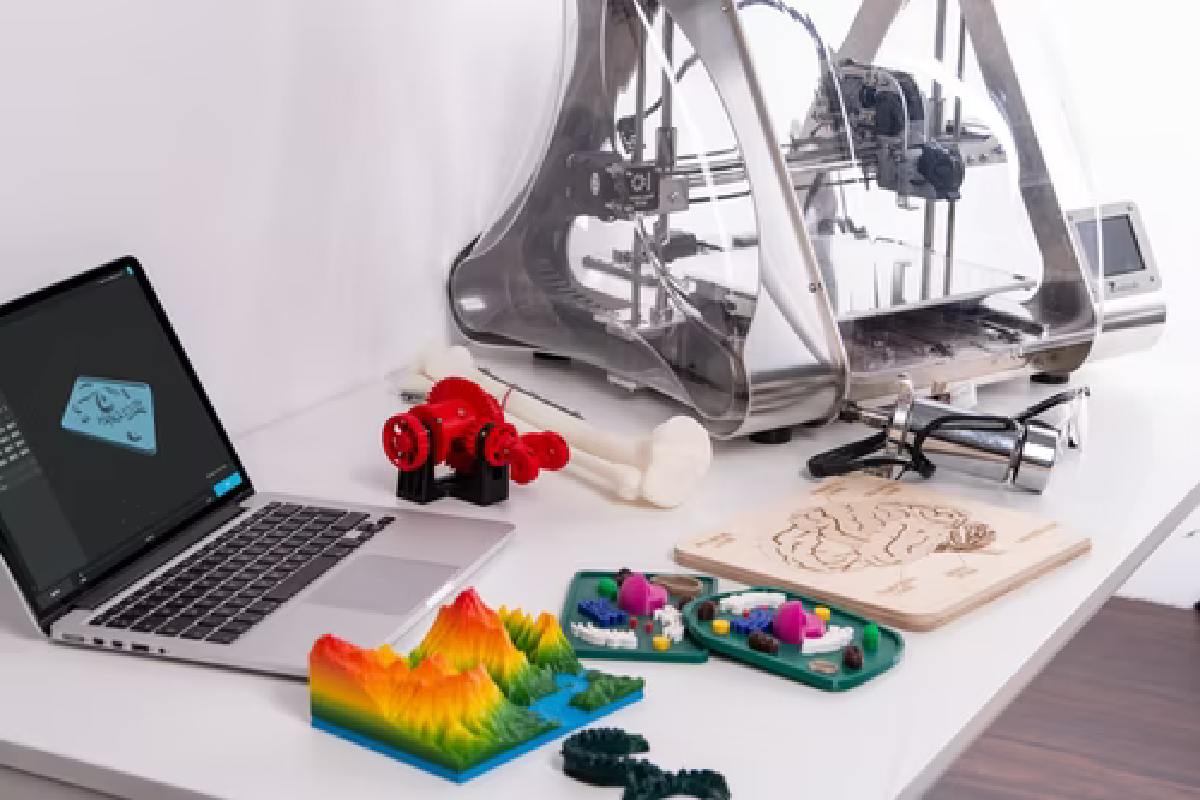
A 3D printer is a device capable of printing in three dimensions. We are used to printing on matte paper with the usual printers. But with this 3D printer, our objects will have volume, which can give a lot of play.
3D printers appeared long before they became famous for home use, so we could see 3D printers in the mid-80s. As something exceptional today, they are commercial and take up relatively little space that has been domesticated. And we can buy one to print our objects at home.
The 3D printer can work with different materials. Although the most common is to find those that inject polymers such as PLA or ABS. In this case, this material is melted, building delicate layers deposited on top of each other until the desired object is made. This method needs excellent calibration to obtain better quality.
There are also printers based on photosensitive resins that offer better quality in return. The objects that can be created are smaller in size. In this case, the resin is photosensitive, and through ultraviolet light, it solidifies the layers which are deposited one on top of the other until the final model is built. There are different common types, such as agglomerating ink or laser to compact the already solidified powder.
This Article Is belongs to the Gadget Guides
Table of Contents
CAD Type File
To create these 3D objects, it is necessary to provide the printer with a CAD-type file with the object’s design to print it. In addition to connecting it to your PC to print, they generally have a screen and a USB and SD card reader where you can insert these files so that the printer can work autonomously. We select the model, and the printing will start.
Unfortunately, they are not as fast as a laser printer, and it can take some hours to print a small object. It will depend on the quality and volume of what you want to print.
The CAD model is an important part of the process because the printer needs detailed digital instructions before it can create the physical object. Depending on the complexity of the design, the preparation and printing process can take considerably more time.
What is a 3D Printer for?
The 3D printer is used to print objects with volume and material according to the use that we will give. With a 3D printer, we can manufacture things that can be used for everyday use or even replace or improve others.
They usually sell some 3D printer kits to make them yourself in which, once finished, it will be necessary to print some pieces with this printer itself, although they remain unfinished. Objects can be of any type limited to a maximum size, but designers also invent ways to break them into pieces and make larger objects with subsequent assembly.
These printers are widespread in the medical field; thanks to technological advances, personal prostheses can be printed at a low cost and almost immediately. Using a 3D scanner or designing the model precisely, we can print the type of prosthesis necessary for each patient. It is even possible to print custom-made corsets that are much less cumbersome than those commonly seen.
In engineering or R&D, a 3D printer can provide you with previous models to work with. In this way, you can have a prototype beforehand that you can make and print yourself to correct later in case of failure. You can also print some necessary pieces to continue with the project and even adapt them to your needs.
With a 3D printer, we can print our figures or collectibles or invent all kinds of supports or gadgets to improve our day-to-day life. You have to let your imagination fly, design the object to be created in a program, and wait a few hours for it to be ready.
Once finished, we can treat it to obtain a better result; you can even paint it to make it look better.
3D Printing for Everyday Projects
One of the reasons 3D printing has become popular is its ability to produce customized objects. Instead of purchasing a ready-made product, users can create a digital design and manufacture an object according to their requirements.
For example, a 3D printer can be used to create:
- Phone and tablet stands
- Cable organizers
- Replacement parts
- Small storage containers
- Decorative objects
- Toys and collectibles
- Custom brackets and holders
- Educational models
- Prototypes for new products
This makes 3D printing particularly useful for people who enjoy technology, DIY projects, design, and creative hobbies.
Technology enthusiasts who enjoy experimenting with different devices can also explore other innovative products, including the gadgets that you can use on your vacation. Many of these portable gadgets can complement a technology-focused lifestyle.
How Does 3D Printing Work?
The basic 3D printing process begins with a digital model. The model can be created using CAD software or obtained from a 3D scanner.
After the model is ready, specialized software divides the design into many thin horizontal layers. These instructions are then sent to the printer.
The printer creates the object one layer at a time. Depending on the printer type, it may melt plastic filament, cure liquid resin using light, or deposit another type of material.
After all layers have been completed, the finished object can be removed from the printer. Some objects may require additional processing, such as removing support structures, sanding, cleaning, or painting.
Common Types of 3D Printing
There are several 3D printing technologies available today.
FDM 3D Printing
Fused Deposition Modeling (FDM) is one of the most common forms of 3D printing. It uses a filament, such as PLA or ABS, which is heated and deposited through a nozzle.
FDM printers are widely used by hobbyists, students, and small businesses because they are relatively accessible and can create a wide variety of objects.
Resin 3D Printing
Resin printers use liquid photosensitive resin. Ultraviolet light cures the resin layer by layer to create the final object.
This technology can provide highly detailed prints and is often used for miniatures, models, jewelry designs, and other projects where fine details are important.
Powder-Based Printing
Some industrial 3D printers use powdered materials and energy sources such as lasers to selectively solidify or fuse the material.
These systems can be used for specialized manufacturing applications and may support materials that are not suitable for conventional home 3D printers.
3D Printing in Technology and Innovation
3D printing has become an important technology for prototyping and experimentation. Designers can create a digital model, print it, test it, and make changes without manufacturing a large number of products.
This can reduce the time required to test new ideas.
For example, an engineering team developing a new product can create a prototype using a 3D printer. After testing the prototype, the team can modify the digital design and print an improved version.
The same approach can be useful for educational projects. Students can create physical models to better understand engineering, architecture, science, and other technical subjects.
Technology continues to develop in other areas as well. For example, gaming enthusiasts can explore modern console technology through information about the PS5, while people interested in unmanned technology can learn more from this guide to drones.
Advantages of 3D Printing
3D printing provides several advantages compared with traditional manufacturing methods.
- Customization: Objects can be designed according to specific requirements.
- Rapid prototyping: Designers can quickly create and test physical prototypes.
- Reduced material waste: Some printing techniques use material only where it is required.
- Complex designs: Certain printers can create shapes that are difficult to manufacture using traditional methods.
- On-demand production: Objects can be produced when they are needed.
- Educational value: 3D printers provide hands-on learning opportunities.
- Creative freedom: Users can turn digital designs into physical objects.
Limitations of 3D Printing
Although 3D printing offers many benefits, it also has limitations.
Printing can take several hours depending on the size and complexity of an object. The final result can also depend heavily on printer calibration, material quality, printing temperature, layer height, and other settings.
Some 3D printers are also limited by their build volume, meaning they cannot produce objects larger than the available printing area without dividing them into multiple parts.
Different materials also have different properties. Some may be strong and durable, while others are better suited to decorative or prototype applications.
More about What is a 3D Printer
A 3D printer is a type of printer that can create three-dimensional objects by depositing material layer by layer based on a digital model or blueprint. It uses a variety of materials, such as plastics, metals, and ceramics, to produce physical objects of different shapes and sizes.
The process of creating a 3D-printed object involves several steps. First, a 3D model is created using computer-aided design (CAD) software or a 3D scanner. The 3D model is then loaded into the 3D printer, which slices the model into layers and prints each layer one at a time, using the chosen material.
3D printers have many applications in a variety of industries, such as manufacturing, healthcare, and education. In manufacturing, 3D printing is used to create prototypes and tooling, as well as produce finished products with complex geometries.
3D printing is used to create custom prosthetics and implants, as well as to produce models for surgical planning in healthcare. In education, 3D printing is used to teach STEM subjects and provide hands-on learning experiences for students.
3D printing technology is rapidly advancing, with new materials and techniques being developed to increase the speed, precision, and capabilities of 3D printers. As a result, the cost of 3D printers has decreased over time, making them more accessible to individuals and small businesses.
With the ability to produce custom parts and objects on demand, 3D printing is becoming an increasingly important tool for innovation and creativity in many fields.
Conclusion
A 3D printer transforms a digital design into a physical three-dimensional object by building it layer by layer. Although printing can take time and requires proper calibration, the technology provides significant opportunities for customization, prototyping, education, manufacturing, and creative projects.
From simple household accessories to engineering prototypes and specialized medical applications, 3D printing continues to expand into new areas. As printers, materials, and software improve, the technology is likely to become even more useful for individuals, businesses, educators, designers, and engineers.